
Some of the Unknown Facts and Traditions Surrounding the “Festival of Lots”
Purim, also known as the “Festival of Lots,” is almost here, with the holiday being celebrated from sundown on Monday, March 2 until sundown on Tuesday, March 3. Also known as the “Jewish Carnival” due to its highly festive nature, Purim pays homage to the prevention of the slaughter of the Jewish people in the Achaemenid Empire under the prime minister Haman, as set forth in the Book of Esther. During Purim, it’s traditional to dress in costume, enjoy festive meals and use “graggers” (traditional noisemakers) to create a cacophony so that Haman’s name cannot be heard. Other traditions include:
- The reading of the Megillah, or long scroll telling the story of how Esther saved the Jewish people from annihilation
- The Mishloach Manot, where friends and family exchange packages with ready-to-eat food items
- The Matanot La’evyonim, where revelers give food or money to persons in need
Some Lesser-Known Things about Purim
Here are some interesting facts and practices related to Purim with which you may be unfamiliar:
- The holiday is celebrated one day later in many walled cities around the world—In the Book of Esther, the Jewish people who lived in the walled capital city of Shushan needed two days to ward off their enemies, whereas those outside the city were able to defeat their foes in just a day. For that reason, Jewish people living inside any city that has been walled since about 1250 BCE celebrate Purim one day after the rest of the world.
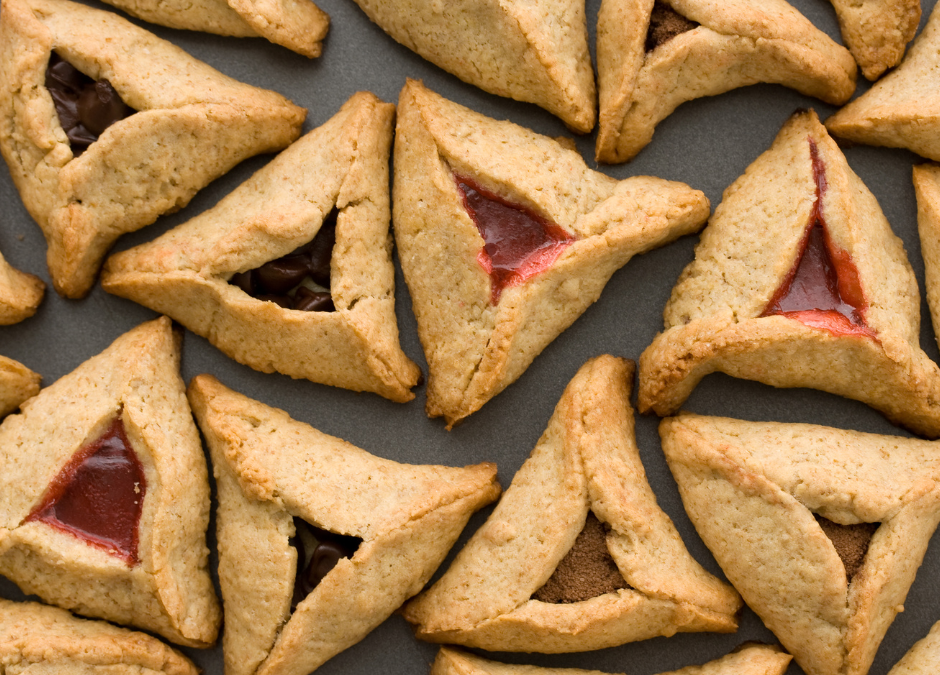
- The beloved cookies that are central to Purim—hamantaschen—have a number of different theories of origin. Some scholars believe they were simply a representation of Haman’s ears and refer to the practice of cutting off a prisoner’s ears before execution. Others suggest that, because the German word “tasche” translates to pocket or pouch, they symbolize the money that Haman offered to the King to obtain permission to slaughter the Jews. Some view the tri-cornered pastry as the three patriarchs who gave Esther the strength to seek protection for the Jewish people, whereas another interpretation suggests the cookie’s shape is simple a fertility symbol.
- Sending is preferred to giving, according to the specific language of the Book of Esther—The verse that serves as the basis for mishloach manot uses language of sending, not of giving. For that reason, it’s become common practice to send your gifts through an intermediary, rather than delivering them yourself.
- One of the most unusual Purim celebrations ever took place inside a castle confiscated by Allied forces from former Nazi propagandist Joseph Goebbels—In 1945, Jewish soldiers in Germany set up candles in the dining room of the former high-ranking Nazi official and told their Gentile compatriots the story of Purim.
- Many scholars believe the Book of Esther to be apocryphal, based on Babylonian legend, but adapted to reflect the true realities of Jewish people in exile.
- Some believe that the Talmud mandates intoxication, as the Megillah says that revelers must consume alcohol on Purim until they cannot tell the difference between the phrases “blessed be Mordechai” and “cursed be Haman.” Most celebrants now believe that such admonitions are not literal and believe that alcohol use should be moderate at most.
Gutterman’s and Gutterman Warheit—Serving the Jewish Community for More than 130 Years
At Gutterman’s and Gutterman Warheit, with funeral chapels in New York and Florida, we bring more than six generations of experience to individuals and families in the Jewish community who need funeral and/or burial services. Because of our extensive experience, we know the distinct customs within each Jewish tradition and can help with any issue or concern, from the structure of the memorial services or the selection of a casket or monument to the details of sitting Shiva or the preparation of a Yahrzeit calendar. We will also work directly with the Chevra Kadisha to ensure compliance with Jewish law in the preparation of the body.
To learn how we can help, send us an email or call us at one of the numbers listed below.
Gutterman’s & Gutterman Warheit — Where Relationships Matter
Family Owned and Operated Since 1892
Rockville Centre: (516)764-9400 | Woodbury: (516)921-5757 | Brooklyn: (718)284-1500
Boca Raton, FL: (561)997-9900 | (800)992-9262