
Game Continues to Rise in Popularity
Dreidel is just a children’s game, right…a way for kids to enjoy Hanukkah. Not anymore! Over the last 20 years, there’s been a marked resurgence in interest in the traditional Jewish game, with much of the expansion of interest found among adults. There are now competitive dreidel leagues, dreidel video games and virtual dreidel platforms.
What Is Dreidel?
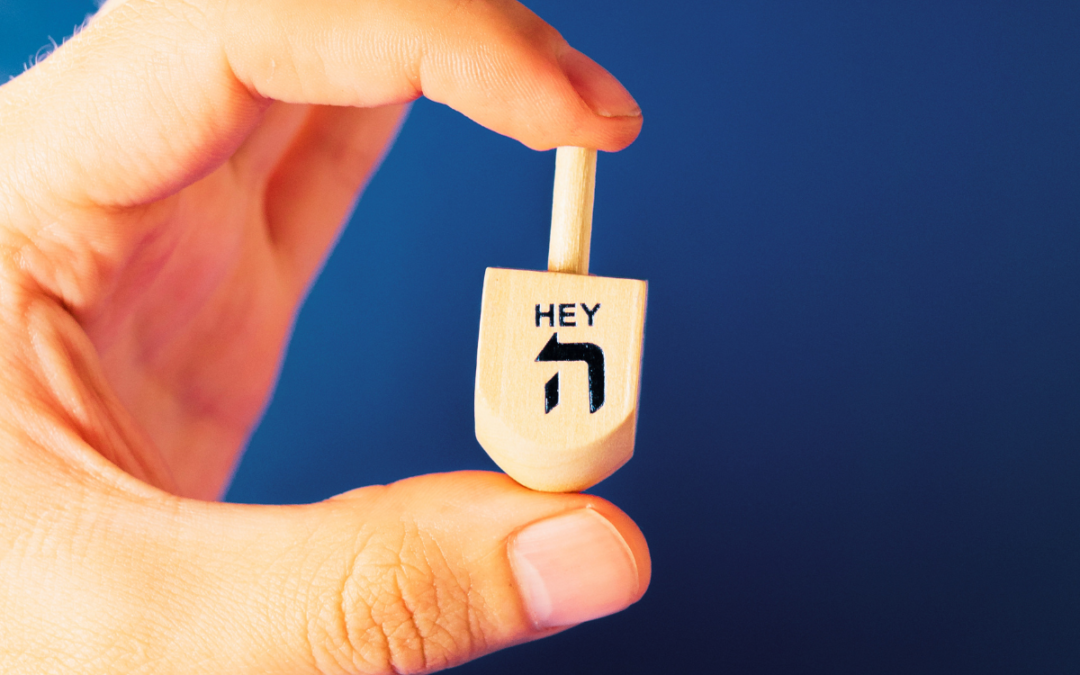
The term “dreidel” refers to a distinctive, four-sided spinning top used to play a game during the Jewish holiday of Hanukkah. Each side of the top has a Hebrew letter on it:
- Nun, which stands for nothing
- Gimel, meaning “entire” or “whole”
- Hei, for “half”
- Shin, translated as “put in”
Each player starts the game with the same number of pieces, which are customarily prize-like items, such as pennies, raisins or chocolate gelt. Each player antes a piece to start the game or when the pot is empty. The players than take turns spinning the top, and respond according to the letter that they throw, with four results:
- Nun, the player does nothing
- Gimel, the player takes the whole pot
- Hei, the player gets half the pot (always rounding up, if necessary)
- Shin, the player must put one game piece into the pot
A player who loses all his or her pieces is out of the game, but typically may borrow pieces from another player. The game is over when one player wins all the game pieces.
How Did Dreidel Originate?
Though legend suggests that Jewish children used the dreidel to conceal Torah studies from the Greeks, the first dreidel-like object was found in the 1500s in England and Ireland as a gambling toy. That four-sided top was known as a teetotum. The term “dreidel” comes from the Yiddish, meaning “to turn or spin.” Most historians now believe that dreidel was popularized within the Jewish community in the late 1700s, as the teetotum had by that time become well-known across Europe.
The Worldwide Rebirth of Dreidel
Most aficionados point to the mid-to-late 2000s as the beginning of the renewed interest in dreidel:
- In 2007, Eric Pavony established Major League Dreidel (MLD), appointing himself as the league’s first “Knishioner.” He also developed the “spinagogue,” a tabletop arena that converts the relatively slow-paced children’s game into a professional sport. A felt-lined board measuring approximately 12 x 14 inches, circumscribed with a 3.5 inch barrier, the spinagogue keeps the tops contained. The contestants vie to see who can achieve the longest TOS (time of spin). Commonly referred to as a “spoof sport,” MLD features players with punny names, such Torah-dactyl or Oscar de la Menorah. As a general rule, the players, though highly competitive, are paid in chocolate gelt. MLD takes pride in being open to anyone, noting that some of its top performers are not Jewish.
- Also in 2007, Jennie Rivlin Roberts and her husband, Webb, introduce a new game called “No Limit Texas Dreidel” through their company Modern Tribe. In this version, which merges dreidel with no limit Texas hold-em poker, players each get two spins (which only they can see). The letters on those spins are then combined with three “community” spins, allowing the players to form a poker hand with the five spins. All poker betting rules apply. Payment is typically in gelt.
- In 2009, Good Morning America aired a feature piece on the “Dreidel Renaissance”
- In 2013, Adam and Shelley Zucker released Super Dreidel, a board game with two tops, a gameboard of Stars of David, a menorah and poker chips
Gutterman’s and Gutterman Warheit—Serving the Jewish Community for More than 130 Years
At Gutterman’s and Gutterman Warheit, with funeral chapels in New York and Florida, we have provided comprehensive funeral and burial services for over six generations. Because of our unmatched experience, we understand the different practices within each Jewish tradition and can help you with all matters related to a funeral or burial, from the order of service at the memorial or the selection of a casket or monument to the arrangements for sitting Shiva or the preparation of a Yahrzeit calendar. We will also work directly with the Chevra Kadisha to ensure compliance with Jewish law in the preparation of the body.
To learn how we can help, send us an email or call us at one of the numbers listed below.
Gutterman’s & Gutterman Warheit — Where Relationships Matter
Family Owned and Operated Since 1892
Rockville Centre: (516)764-9400 | Woodbury: (516)921-5757 | Brooklyn: (718)284-1500
Boca Raton, FL: (561)997-9900 | (800)992-9262